4 Hardware Solutions for Professional Link-Kabel Data Exchange
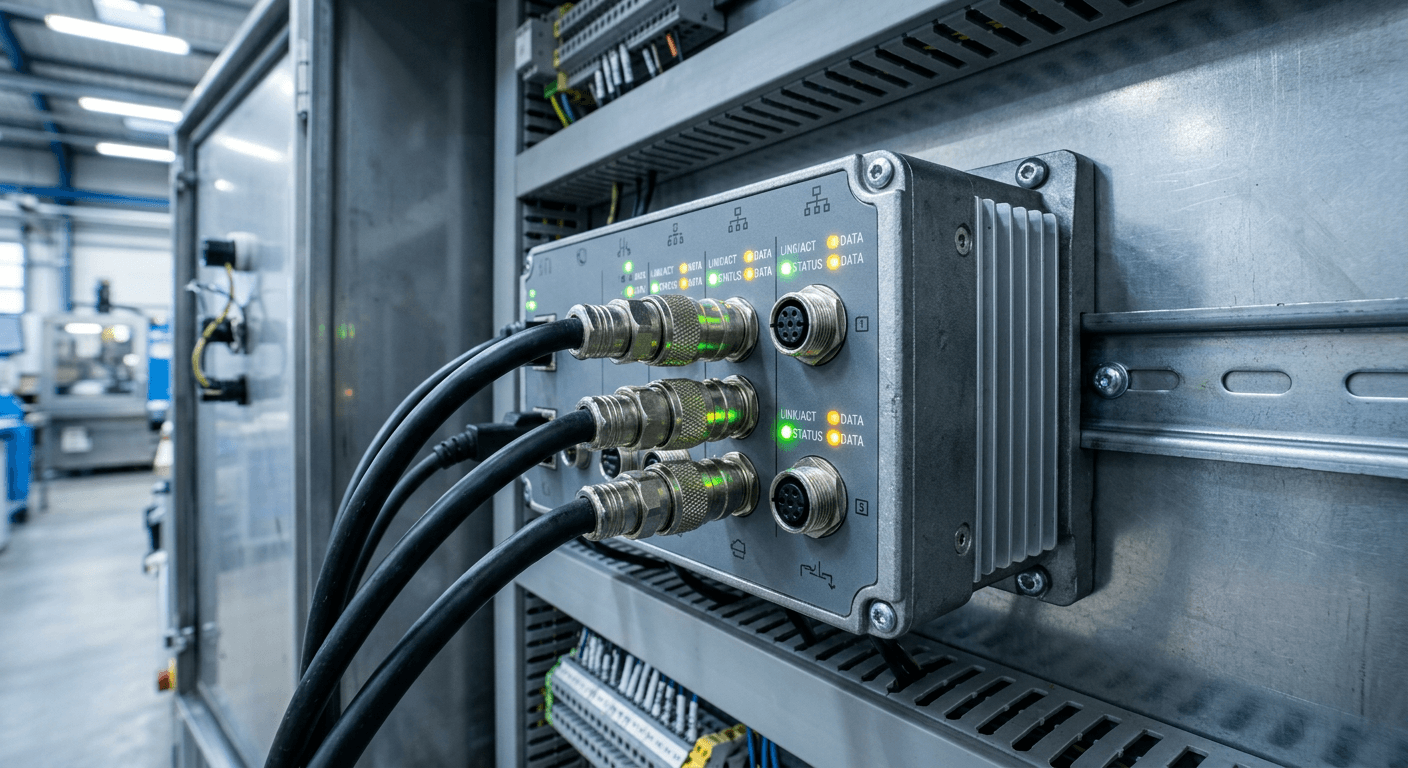
Many facility managers assume that upgrading an automation network requires ripping out every legacy sensor and physical link-kabel on the floor, when the actual bottleneck sits at the aggregation layer. Facilities push massive amounts of diagnostic and cyclic data through networks built decades ago, leading to dropped packets, saturated programmable logic controllers (PLCs), and blind spots in telemetry. The hardware that bridges the gap between field devices and enterprise networks dictates how much data you can extract without crashing the system.
Quick Summary
Industrial network master modules act as the central routing hardware between field-level sensors and upper-level computing networks, translating raw signals into usable IT and operational technology (OT) data. Choosing the correct gateway prevents network saturation and isolates automation tasks from heavy diagnostic telemetry.
- Determine your data topology before buying hardware.
- High-amperage modules eliminate the need for secondary power supplies.
- Video telemetry requires dedicated serialization, not standard sensor protocols.
- Isolating IT data from OT traffic prevents controller latency.
Table of Contents
- Data Topology: How to Choose a Master Module
- 1. ifm IO-Link Master
- 2. Balluff IO-Link Master
- 3. Bihl+Wiedemann IO-Link Master
- 4. Videtronic V-Link
- Aligning Topology with Hardware
- Recommended Reads
| Product | Data Topology | Features | Pros | Cons | Target Audience |
|---|---|---|---|---|---|
| ifm IO-Link Master | IT/OT Bridge | Dual data exchange, independent IT routing | Zero PLC load for IT data, robust casing, parallel processing | High unit cost, over-engineered for simple loops, complex initial mapping | Facilities driving Industry 4.0 analytics |
| Balluff IO-Link Master | Cyclic Automation Hub | M12 L-coded connections, 16 A total current | Heavy power delivery, multi-tier classes, wide protocol support | Thick cabling required, overkill for low-power sensors, rigid network polling | Lines with heavy motorized actuators |
| Bihl+Wiedemann IO-Link Master | Granular Port Controller | 1 to 8 port sizes, 32 Bytes per port data limit | Exact port matching, safety-system integration, lean footprint | Hard 32-Byte limit, less suitable for heavy vision, requires exact capacity planning | Tight enclosures with limited nodes |
| Videtronic V-Link | Video Telemetry Kit | GMSL2 serialization, MAX96717/MAX96714 chips | 15-meter reach on coax, zero video latency, Raspberry Pi integration | Restricted to 15 meters, compute ecosystem lock-in, single-purpose design | Robotics and vision system integrators |
Data Topology: How to Choose a Master Module
Evaluating the physical link kabel infrastructure is only the first step; the determining factor for industrial hardware is the Data Topology. This classification lens defines how the module processes, routes, and restricts the flow of information before it ever hits your main network. Comparing a heavy-duty power distribution hub against a dedicated video serializer is a useless exercise because they govern entirely different types of traffic.
We categorize these solutions into four distinct topologies. An IT/OT Bridge separates operational control from diagnostic telemetry, preventing heavy data analytics from slowing down physical machinery. A Cyclic Automation Hub focuses on continuous, heavy-duty polling and power delivery, suited for environments where the physical actuation demands as much bandwidth as the data itself. A Granular Port Controller is built for precise scaling, allowing facilities to match the exact node count without leaving dead ports on the network. Finally, a Video Telemetry Kit handles massive, continuous data streams that would instantly crash standard sensor protocols, converting parallel data into high-speed serial streams.
1. ifm IO-Link Master
Raw field data arrives at the aggregation block and immediately splits into two isolated streams, sending operational metrics to the logic controller while pushing diagnostic payloads directly to the enterprise server. The ifm IO-Link Master is built specifically for this dual-path processing, functioning as an IT/OT Bridge for facilities that need heavy diagnostic data without interrupting machine control.
Traditional fieldbus modules force all data through the primary controller. If an enterprise dashboard needs temperature data from a proximity sensor, the PLC has to request it, process it, and hand it off to the IT layer. The ifm architecture bypasses this limitation. It maintains the cyclic data exchange with the PLC for real-time machine control, but mechanically opens an acyclic, direct channel to IT networks. This allows backend servers to harvest parameters, diagnostics, and event logs entirely independent of the automation cycle.
Simultaneous dual-path routing removes the PLC bottleneck
What makes me hesitate to specify this for every facility is the commercial reality of its engineering. The AL1402 model has a published list price of 510,70 €. When integrating a simple, two-sensor loop that only requires basic on/off state monitoring, absorbing that cost per module rapidly breaks integration budgets. The hardware is fundamentally over-engineered for basic control loops that do not push data up to an analytics dashboard. It should not be compared against basic terminal blocks.
Deploy this unit when your enterprise analytics team demands continuous sensor diagnostics that your current logic controller lacks the processing bandwidth to deliver.
Pros
- Prevents controller latency by splitting data paths
- Eliminates the need for intermediary data extraction gateways
- Industrial-grade housing survives harsh floor environments
Cons
- Premium price point for the AL1402 model
- Unnecessary complexity for isolated, non-networked machines
- Requires configuration across two distinct network layers
2. Balluff IO-Link Master
When a production line reaches its physical limit for routing individual sensor wires back to a centralized cabinet, engineering teams typically start looking for a decentralized aggregation module. The Balluff IO-Link Master operates as a Cyclic Automation Hub, designed to pull both the data traffic and the physical power delivery out onto the machine frame.
This master works on the principle of continuous, cyclic data exchange with connected slave devices, bundling that telemetry and sending it via the master network to higher control systems running Profibus, Profinet, or standard Ethernet protocols. Mechanically, its defining feature is power distribution. The standard models utilize M12 L-coded connections. Instead of routing a secondary, thick power harness alongside the data cables to drive heavy actuators, this module handles both. It supports up to 2 A per individual port, with the chassis capable of handling up to 16 A of total current.
Practical rule: Evaluate your simultaneous current draw before assigning multiple heavy actuators to a single hub; exceeding the 16 A chassis limit will trigger a protective bus fault regardless of how much individual port capacity remains.
Amperage capacity dictates the actuator count
The structural limit of this hardware is its reliance on matching tiers to network complexity. Balluff makes the hardware available in three distinct classes: Entry, Standard, and Advanced. Buyers who blindly order the Entry class for a network requiring heavy programmatic parameterization will find the module incapable of handling the required data strings, while those over-buying the Advanced tier for simple proximity polling will waste capital on unused protocol features.
Select this hardware if your machine design requires pushing substantial electrical current to field actuators through the same module handling the network traffic.
Pros
- Massive 16 A total current ceiling
- Consolidates power and data into a single module footprint
- Available in multiple tiers to scale with network complexity
Cons
- Tiered feature sets require careful upfront specification
- Thick M12 L-coded cables require larger routing trays
- Rigid cyclic polling is less efficient for event-driven telemetry
3. Bihl+Wiedemann IO-Link Master
How much cyclic process data can a facility genuinely push through a single connection node before the network cycle time degrades? The Bihl+Wiedemann IO-Link Master is a Granular Port Controller that integrates standard and safety-related field devices directly into the primary control system, focusing entirely on lean, precise data allocation.
Instead of acting as a massive power distributor, this edge gateway handles the exacting digital handshake between field devices and the logic controller. The mechanism relies on strict bandwidth allocation. The hardware guarantees up to 32 Bytes of cyclic process data per port. By strictly capping the payload size, the module ensures that the cycle time remains deterministic, meaning the controller receives the data at the exact microsecond it expects it, without jitter. To accommodate different physical footprints, the company offers these masters in configurations of 1, 2, 4, and 8 ports.
Port modularity stops you paying for empty sockets
I would hold off on this hardware if the integration involves complex vision systems or advanced telemetry sensors. The strict ceiling of 32 Bytes of cyclic process data per port is a hard boundary; sensors that require larger data blocks for profile outputs or continuous array streams will either choke at the port or require complicated acyclic fragmentation that defeats the purpose of real-time control.
Purchase this edge gateway when you need to match the exact hardware port count to a small machine station without leaving unsealed, vulnerable sockets exposed on the floor.
Pros
- Exact scaling with 1, 2, 4, and 8 port options
- Predictable cycle times through strict data allocation
- Telephone tech support available directly (+49 621 33996-449)
Cons
- 32-Byte cyclic limit restricts heavy data payloads
- Not suitable for high-definition visual arrays
- Smaller port configurations increase the per-node integration cost
4. Videtronic V-Link
An integration engineer trying to route high-definition telemetry through a moving robotic arm quickly discovers the fragility of standard wiring harnesses under continuous strain. The Videtronic V-Link is a dedicated Video Telemetry Kit, often replacing older c-link standards for video, built entirely to solve the physical limitations of visual data transmission in automated environments.
This ready-to-use hardware connectivity kit functions on GMSL2 (Gigabit Multimedia Serial Link) technology. The mechanism takes a heavy, parallel video feed and compresses it. The kit includes a serializer module based on the MAX96717 chip, which converts the video into a high-speed serial stream. This stream travels over a single, highly flexible coaxial cable. At the receiving end, a deserializer module based on the MAX96714 chip reconstructs the original feed. The hardware is specifically engineered for platform compatibility with Raspberry Pi 4, 5, and Zero 2 compute modules.
Hardware serialization offloads the processing overhead
The honest limit of the v link architecture is its physical range and its strict compute ecosystem. It supports data and video transmission over distances of up to 15 meters. If a facility requires routing a camera feed across a 50-meter warehouse floor back to a central server rack, this single-coaxial setup will fail. Furthermore, it is entirely restricted to Raspberry Pi architectures; attempting to wire this into a standard industrial PLC is impossible.
Opt for this serializer kit if you are building autonomous robotics on a Raspberry Pi backbone and need to route zero-latency video through high-flex machine joints.
Pros
- Single coaxial cable heavily reduces wiring mass
- Dedicated MAX96717/MAX96714 chips handle all serialization
- Native compatibility with Raspberry Pi ecosystems
Cons
- Hard transmission limit of 15 meters
- Incompatible with standard industrial PLCs
- Serves no purpose outside of video and telemetry data
Aligning Topology with Hardware
Matching the right hardware to the factory floor requires looking past the port count and focusing on the underlying data topology. Misunderstanding how a module routes its traffic guarantees either network congestion or burned-out modules.
If your bottleneck is data isolation, choose an IT/OT Bridge. This keeps the heavy, continuous stream of analytical data completely separate from the real-time commands keeping the machinery running safely.
If your priority is eliminating secondary power supplies, specify a Cyclic Automation Hub. Pushing high amperage through the same M12 L-coded module that handles your data polling drastically reduces the cabling footprint on the machine frame.
If you are dealing with scattered, low-density sensor clusters, implement a Granular Port Controller. Matching a 1- or 2-port module exactly to the physical location prevents running excess cable back to a centralized 8-port block.
If you are integrating computer vision into moving robotics, rely on a Video Telemetry Kit. Standard sensor networks cannot handle the bandwidth of live video, making dedicated hardware serialization mandatory for stable processing.